


«Two screws — that’s forbidden!»
This principled objection sometimes comes up when people think about simply mounting a medal. It is true that when we talk about «heritage enhancement», we quickly think of castles, churches or highly protected historic buildings (assets of regional or national importance).
That is often the exception: there are countless «small heritage» sites where the issue does not arise at all.
When designing Genius Loci medals, and by asking heritage protection specialists directly, their answer was always much more nuanced and generally very supportive of our approach:
– The ultimate purpose of facade protection rules is clearly to avoid degrading or distorting built heritage.
That obviously rules out marketing-style displays (panels, banners…) that take up visual space, especially when they have nothing to do with the site.
In Genius Loci’s case, the purpose of the medals is specifically to showcase the Place, to explain why it matters — which falls entirely within the mission of heritage protection.
What is the point of protecting heritage if no one is told what makes it valuable?
Moreover, the medals are small and discreet enough to be placed elegantly near the site without affecting it.
– In practice, rather than drilling into Carrara marble or 14th-century wood, there is always an alternative: fix the medal in recent masonry, a nearby public bench, a picnic table, a railing or a post…
Rather than drilling a medal into the cathedral facade, you could place a dozen (linked to the same Place) on public benches nearby… They would be more visible too.
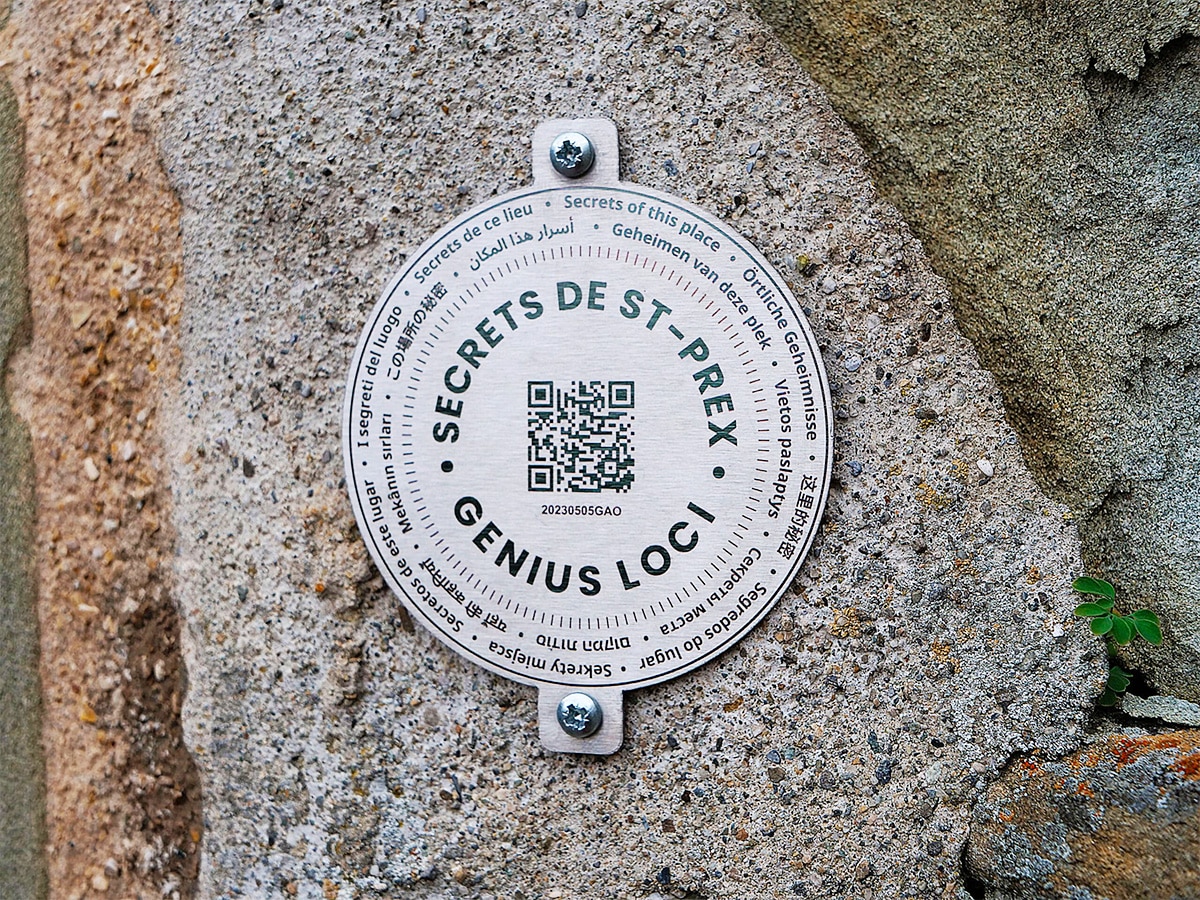
This medal was installed on the historic Bourg Gate of St-Prex in Switzerland — a nationally protected building of major heritage importance. The rules were strict; a recent masonry joint was used to mount the medal in clear view, right beside the gate.